
1. What are the SBIR and STTR programs?
Before we get started, let’s go over some definitions:
- Grant Solicitation: This is the formal announcement by the funder inviting applications for funding of specific topics that are of importance to that Federal Agency/funder. It includes all critical information you will need to write and submit your application.
- Common Solicitation Types: Broad Agency Announcement (BAA), Request for Application (RFA), and Notice of Funding Opportunity (NOFO).
- Letter of Intent (LOI): Pre-application materials that may be required by the Federal agency prior to a full application.
- Commercialization: Process of advancing your technology/product to the open market for use by or within a specific industry.
- Feasibility: The practical extent to which a project can be performed successfully.
- SBIR: Small Business Innovation Research
- STTR: Small Business Technology Transfer
- Phases: SBIR and STTR are further defined by their “phases,” which are completely different from Clinical Trial Phases. Phases define, in part, what stage of development the product is in.
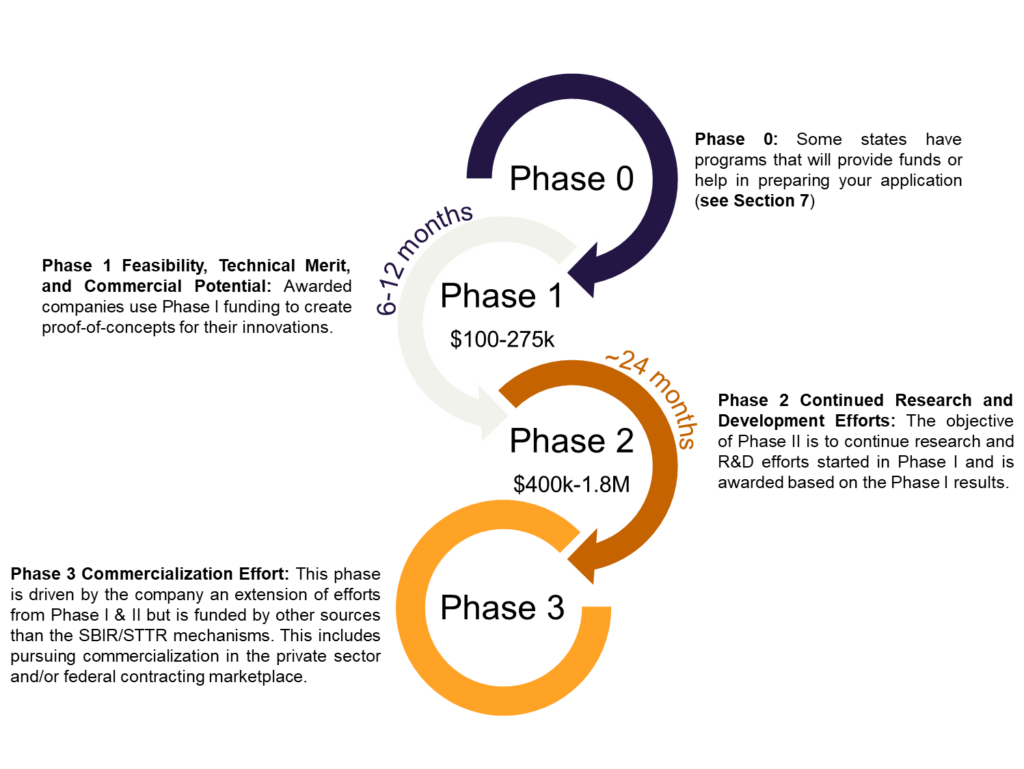
- Phase 0 (optional): Some states have programs that will provide funds or help in preparing your application (see Section 7)
- Phase I: Feasibility, Technical Merit, and Commercial Potential. Awarded companies use Phase I funding to create proof-of-concepts for their innovations. Time frame is generally 6-12 months, and award amounts can range from $100k-$275k, depending on the agency.
- Phase II: Continued Research and Development Efforts. The objective of Phase II is to continue research and R&D efforts started in Phase I and is awarded based on the Phase I results. Time frame is roughly 24 months, and award amounts can range from $400k-$1.8M, depending on the agency.
Phase III: Commercialization Effort. This phase is driven by the company an extension of efforts from Phase I & II but is funded by other sources than the SBIR/STTR mechanisms. This includes pursuing commercialization in the private sector and/or federal contracting marketplace.
Figure 1. Phases of SBIR/STTR
Misson and Goals of the SBIR and STTR Programs
The mission of the program is to support scientific excellence and technological innovation through the investment of federal research funds in critical American priorities to build a strong national economy. The goals of the SBIR and STTR programs are to:
- Stimulate technological innovation.
- Use small businesses to meet Federal Government R/R&D needs.
- Foster and encourage participation in innovation and entrepreneurship by women and socially and economically disadvantaged individuals.
- Increase private-sector commercialization of innovations derived from federal R/R&D funding, thereby increasing competition, productivity, and economic growth.
- Stimulate a partnership of ideas and technologies between innovative small businesses and nonprofit Research Institutions (STTR only).
Who funds these programs?
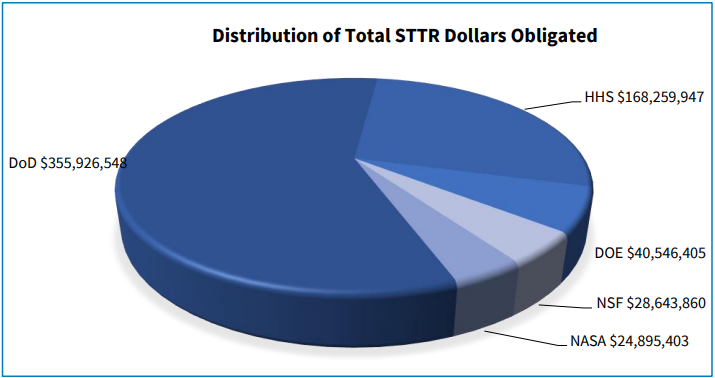
There are 11 total Federal agencies that fund the SBIR mechanism, with only 6 of them also funding STTRs as of 2026. The website for America’s Seed Fund contains a comprehensive list of current funding agencies and their funding caps (https://www.sbir.gov/participating-agencies). It is important to note that each Federal agency may have their own specific requirements for applicants. The pie charts shown below highlight the total dollars that agencies dedicated to SBIR and STTR in 2022 (2022 SBIR and STTR Annual Report, SBA).
Figure 2. Distribution of SBIR Funds Across Government Agencies (2022)
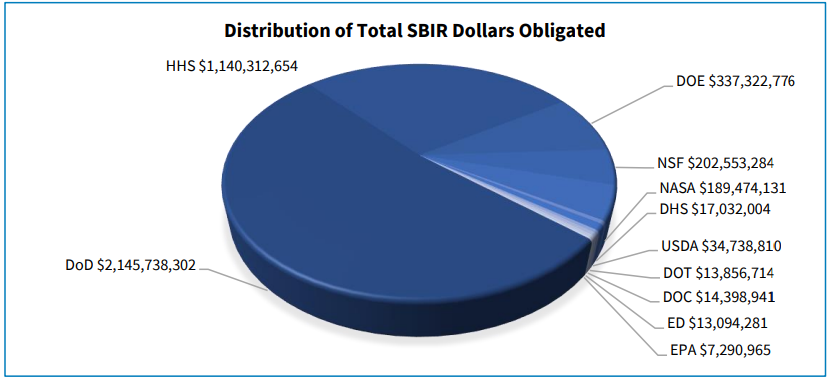
Figure 3. Distribution of STTR Funds Across Government Agencies in 2022 (prior to addition of USDA).
How do I find out if my research fits within an agency’s scope?
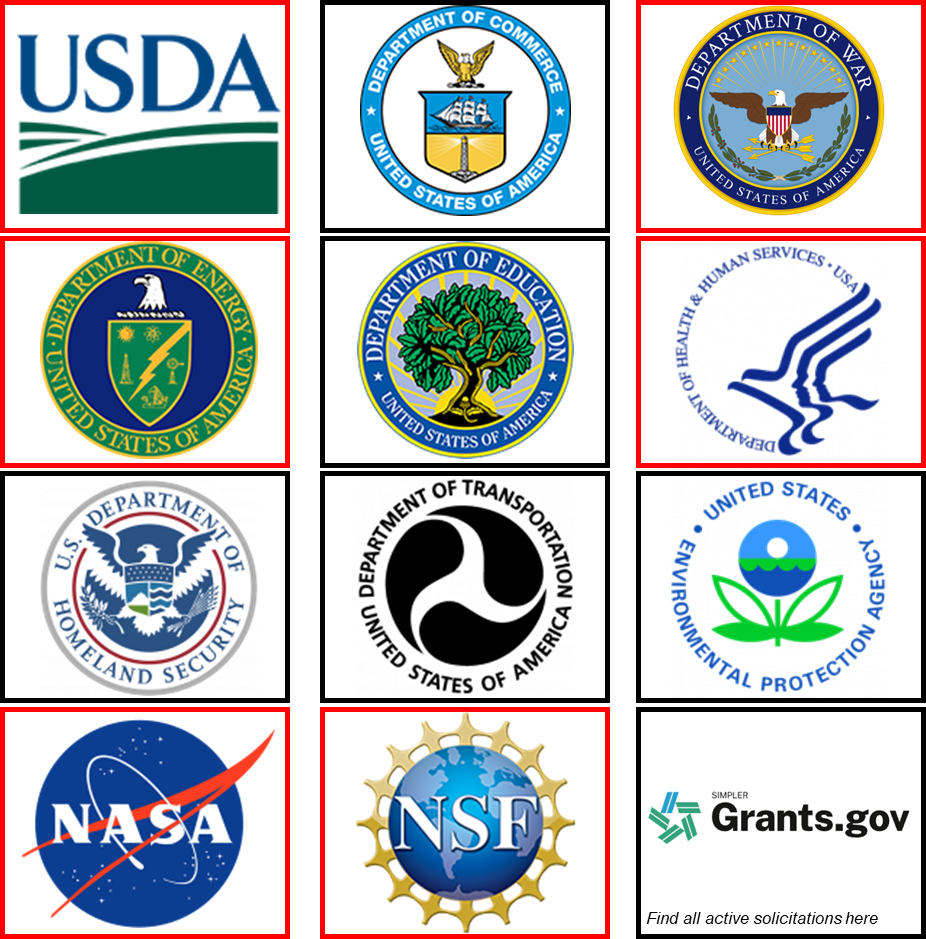
Each Federal agency has different technology focus topics that can be found on their website and the associated grant solicitation. Figure 4 includes a summary of Federal agencies that fund SBIR with the ones that fund STTRs outlined in red. Click on the icon to be sent to that agency’s website for more information.
- US Department of Agriculture (USDA): https://www.nifa.usda.gov/grants/programs/sbir-sttr
- Department of War (DoW, Formerly DoD): https://www.defensesbirsttr.mil/
- Department of Commerce (DOC) (SBIR only, not currently listed on website): https://www.commerce.gov/work-with-us/grants-and-contract-opportunities
- Department of Energy (DoE): https://www.energy.gov/science/sbir/small-business-innovation-research-and-small-business-technology-transfer
- Department of Education (ED) (SBIR Only): https://ies.ed.gov/funding/research/programs/small-business-innovation-research-sbir
- Department of Health and Human Services (HHS): https://seed.nih.gov/
- Department of Homeland Security (DHS) (SBIR Only): https://www.dhs.gov/science-and-technology/sbir
- Department of Transportation (DOT) (SBIR Only): https://www.transportation.gov/osdbu/procurement-assistance/small-business-innovation-research-sbir-program
- Environmental Protection Agency (EPA) (SBIR Only): https://www.epa.gov/sbir
- National Aeronautics and Space Administration (NASA): https://www.nasa.gov/sbir_sttr/
- National Science Foundation (NSF): https://www.nsf.gov/funding/opportunities/sbirsttr-phase-i-nsf-small-business-innovation-research-small-business
- All past, forecasted, and active solicitations are listed on www.Grants.gov
Figure 4. Agencies that fund SBIR (black) or SBIR and STTR (red)
2. Are there special requirements for employment under SBIR/STTR?
The table below includes a brief overview of the main differences between a SBIR and STTR, from the standpoint of the NIH. Each agency may have their own distinct requirements within their solicitations, so it is important to read them carefully.
|
SBIR/STTR Requirements for NIH*** |
||
|
Requirements |
SBIR |
STTR |
|
Principal Investigator (PI)*** |
Primary employment with small business (upon grant award and for duration of project) |
Primary employment with small business (upon grant award and for duration of project) OR single, partnering non-profit research institute (as long as affiliated, holding office with SBC) |
|
Partnering Requirement |
Partnering allowed |
Must partner with non-profit research institution |
|
In house vs. External Work Budget Requirements |
Maximum Budget Breakdown (Subcontract + Consultants):
|
Minimum Budget Breakdown:
|
|
Majority VC Ownership |
Not allowed |
Not allowed |
***The rules for the PI on an STTR can be different depending on the participating agency, so be sure to read the solicitation carefully. At the NSF, for example, the rules on a PI’s eligibility for an STTR are the same as they are on an SBIR project. At the other agencies, the PI can be primarily employed by either the small business or the non-profit organization with which the business is collaborating on the project.
Are Co-PIs allowed on SBIR and STTR applications?
Limited opportunities exist in the SBIR & STTR programs to designate “Co-PI’s” where the role is shared by 2 or more individuals.
- The NIH allows this on SBIR and STTR projects that require a “team science” approach; they refer to this concept as “multiple PIs”. However, the applicants will need to include an in depth explanation for the rationale along with a leadership plan.
NSF uses the term Co-PI with respect to NSF STTR proposals a bit differently. STTR proposals must have a sub-awardee research institution and the lead from that institution is referred to as a Co-PI. Once again, we advise reviewing the solicitation for agency-specific guidance on Co-PIs. You can always contact the agency’s SBIR/STTR program manager to clarify what is allowed or required!
3. Are there only Phase I and Phase II applications with the SBIR/STTR programs?
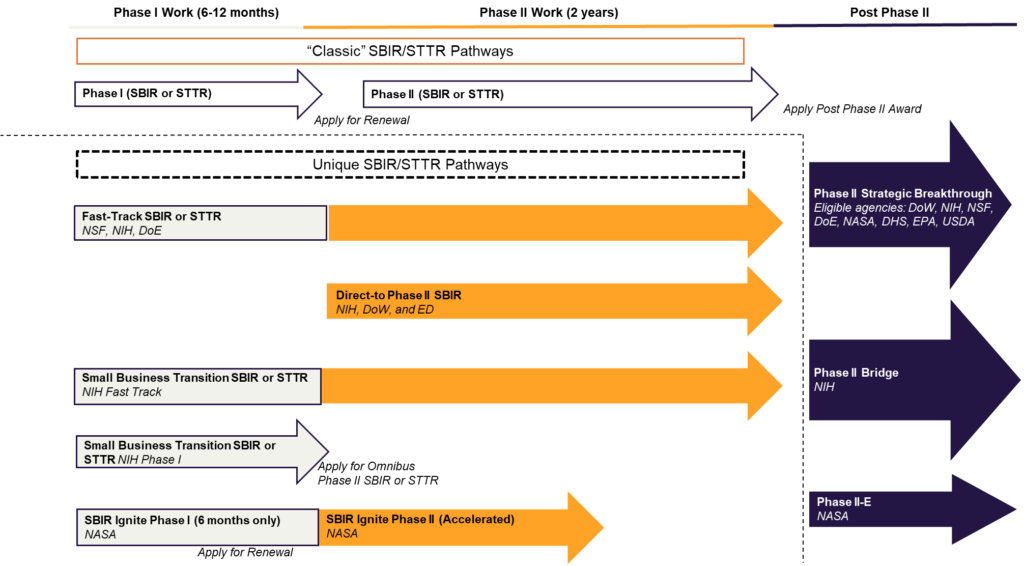
Generally, Phase I and Phase II are the most common types of solicitations found across participating government agencies. The canonical process is such that companies apply for phase I funding to cover their proof-of-concept work and then apply for a phase II renewal after completion of phase I work (Figure 5). However, unique SBIR/STTR opportunities also exist, including the Fast-Track (NIH and NSF), Direct to Phase II (NIH SBIR, DoW SBIR, ED SBIR), and Small Business Career Transition (NIH Only), Phase II-Extended (NASA), SBIR Ignite (NASA), Phase II Bridge (select NIH ICs), Phase II Strategic Breakthrough (DoW, DoE, DHS, EPA, and NASA), and Commercial Readiness Pilot (CRP) (NIH).
- Fast Track: This mechanism (NIH and NSF) covers a continuous project over Phase I and Phase II lifetime. Applicants write the proposal containing aims for each Phase, so there is no gap in funding between the Phases.
- Direct to Phase II (only SBIR): This mechanism allows small businesses that already have strong feasibility and preliminary data for their prototype to bypass Phase I time.
- Small Business Transition (SBIR/STTR, Phase I and Fast Track): These are specific to NIH and designed to support the career development of new entrepreneurs that are early-career scientists with limited entrepreneurial and independent research leadership experience. As it stands, it is unclear if these will be making a comeback after the 2026 re-authorization.
- Phase II-Extended: This program is specific to NASA and is intended to act as a bridge between Phase II and Phase III activities by promoting further research and development (R&D) efforts and supporting the commercialization of innovations that have been developed under the Phase II contract. Phase II-E reduces risk by allowing an investor to contribute funds that the NASA SBIR/STTR program will match, up to $375,000, for an additional funding total of $750,000 on top of a company’s Phase II award.
- SBIR Ignite: This is a different mechanism from the traditional NASA SBIR and STTR and is intended to accelerate time to commercialization. Ignite has a smaller award cohort (9-12 Phase 1) compared to the traditional SBIR mechanism through NASA (~250 Phase 1 awards) due to its focus on support of commercialization outside of NASA and entrepreneurial growth. It also has an accelerate schedule over the traditional mechanism; Phase 1 is 6 months with the Phase 2 proposal being due at the end of the 4th month of Phase 1. It is expected that Phase 2 will be less than 24 months.
- Phase IIB Bridge: Previously supported by NCI and NHLBI, the Phase IIB Bridge program is designed to support later-stage research and development for projects that were previously funded under SBIR or STTR Phase II awards from any Federal agency. The goal of this mechanism is to assist applicants in pursuing the next appropriate milestone(s) necessary to advance a promising product or service along a commercialization pathway. Funding decisions are made, in part, with the ability of the small business to attract 3rd party funding in mind. As it stands, it is unclear if these will be making a comeback after the 2026 re-authorization.
- Phase II Strategic Breakthrough: Small businesses that have received at least 1 prior Phase II award (SBIR or STTR) and can demonstrate 100% matching funds (private capital/non-SBIR/STTR federal funding/or combination) may be eligible for up to $30M USD, depending on the budget of the participating Federal agency. The small business must have market research that shows their technology is an effective solution to an identified need. We anticipate that information will become available as each Federal agency selects their topics. Specific to the DoW, the product must meet necessary readiness levels, priorities, and operational needs. Additionally, the small business only needs 20% matching funds to be eligible.
- Commercialization Readiness Pilot (CRP): This post phase II opportunity is HHS/NIH specific and aims to facilitate the transition of previously (36 moths) or currently funded SBIR and STTR Phase II and Phase IIB projects to the commercialization stage by providing additional support for technical assistance and later stage research and development (R&D) not typically supported through Phase II or Phase IIB grants or contracts. This may include independent replication of key studies, Investigational New Drug (IND)-enabling studies, clinical studies, manufacturing costs, regulatory assistance, or a combination of services. Award size and timeline allowed differs within the participating institutes and centers within the NIH.
Note: Institutes and Centers (ICs) vary in their participation and the types of awards they support. Applicants should always check the solicitation for full details and eligibility.
Figure 5. Funding Timelines for Traditional and Unique SBIR/STTR Mechanisms
4. How do I know if I am eligible to apply for an SBIR or STTR program?
First, you will have to find active NOFOs listed within grants.gov. Your search could include your research topic, SBIR or STTR, and the agency you think you may be aligned with. Second, you will have to ensure your eligibility, both in topic and organizational structure:
- Search for the topic section within the NOFO and make sure your product aligns with the list.
- 2. Each solicitation has an “eligibility” section. Make sure that you and your organization match what is listed for each category:
- Organization type: non-profit, for-profit, or institute of higher education
- Citizenship requirement(s) for PI
- Performance of Work Requirements
- Primary employment of the PI
- Location of the work
- Required partnerships
5. I have found a solicitation I want to apply for. What now?
Pre-application steps can differ for each organization, and they will be listed within the solicitation. Generally, you can count on the steps to include the following:
-
- Company registration. Your company/organization needs to be registered with the appropriate entity (SAM.gov, SBA, Grants.gov, and others) to apply for and receive funding. Some information you will need includes: UEI (unique entity identified), company name, address, ownership information, contact information, point of contact, and number of employees
- Initiation of application with a government agency. This step truly depends on the agency, and instructions will be found within the solicitation and on the agency website. For example, the NSF requires a Project Pitch to be submitted prior to invitation to submit a full application, and some solicitations have an optional or required (DoE) Letter of Intent (LOI). Generally, some agencies may require a white paper, executive summary, or abstract prior to the full proposal (which may or may not be an invite process like NSF SBIR/STTR): consult the solicitation for directions. Learn the etiquette of that specific agency on whether you are encouraged and/or allowed to communicate with the Program Officer/Director with beginning project materials (like a quad chart, concept paper or Specific Aims page). If it is allowed to communicate with the Program Officer/Director, this will allow for the opportunity to receive much needed feedback or information.
- Write the full application. Requirements such as formatting and content are strict and should be followed appropriately. This will include supplemental documentation and your project budget as well. The solicitation will list these requirements out in some level of detail.
- Submit!
6. Where can I find examples of successful SBIR/STTR applications and required documents?
The NIH is the only institute that has full example applications (confidential information redacted). It is important to note that these applications are from prior solicitations where the requirements could have been different.
Example links:
- https://nida.nih.gov/funding/small-business-innovation-research-sbir-technology-transfer-sttr-programs/resources/sample-applications
- https://www.nia.nih.gov/research/sbir/nia-small-business-sample-applications
- https://grants.nih.gov/grants-process/write-application/samples-applications-and-documents
7. What other resources are available to support my Start Up?
There are many different resources available that can assist with grant writing, business assistance, customer discovery, and general learning topics.
Pre-award:
- The NIH SEED (Small Business Education and Entrepreneurial Development) Website contains a wealth of information and resources for those looking to apply for, or have already received, NIH funding. This site includes an overview of business basics, guidance for application preparation, and product development support.
- SEED has a YouTube playlist that contains 37 seminar-style videos that cover a wealth of information spanning the lifetime of your company. Videos include an explanation of the SBIR/STTR process, how to effectively manage your award, Center for Medicare/Medicaid Services (CMS) navigation, and more!
- U.S. Small Business Development Center (SBDC): Small Business Development Centers provide counseling and training to small businesses including working with SBA to develop and provide informational tools to support business start-ups and existing business expansion. Regional centers, like the Missouri SBDC, may offer specialized programs like The Federal and State Technology (FAST) partnership program, which assists small businesses navigate the SBIR and STTR submission process. Work with a SBDC Tech Counselor to learn about lots of educational and professional development workshops in your state/area and submitting a request to the SBDC Net service.
- FAST Program Phase 0 Grants: Some states have Phase 0 grants that support the development of SBIR/STTR proposals. SBA has a compiled list of state and local programs that either provide cash grants and/or cover the cost of specialized assistance to SBIR/STTR applicants as they are developing their proposals.
- Workshops and Online Tutorials: Existing content and new content is released every year from a variety of sources. We have compiled a few here:
- SBA Online Tutorial: This resource features courses designed to help interested parties learn more about the SBIR and STTR programs. From learning the nuances of each agency’s programs to figuring out how to calculate indirect rates, the Online Tutorials covers all the bases within the application process for federal funding. While some tutorials are broad and can be helpful to the novice, others are tailored to more seasoned SBIR/STTR awardees
- NCI SBIR/STTR Training and Entrepreneurship Program: The NCI SBIR/STTR Training and Entrepreneurship Program (STEP) helps small businesses apply for Phase I SBIR/STTR funding
- National Cancer Institute (NCI) SBIR Commercialization Workshops and Webinars
- National Center for Advancing Translational Services Small Business Webinar Resources
- SBIR/STTR Monthly Webinars – Illinois FAST Center: Library of monthly training webinars focused on topics related to preparing and submitting successful SBIR/STTR proposals. Presented and produced by the Illinois FAST Center.
- NASA AMA Sessions for SBIR/STTR and Catalyst Events
- DoE SBIR YouTube Channel and presentation slides
- Department of Education SBIR Video Demonstrations
- DoW Office for Small Business Innovation Webinar Playlist
- DHS Phase 0 2025 Webinar Series
- DHS Deconstructing SBIR Webinar Series
- NSF America’s Seed Fund YouTube Playlist
- NSF Q&A Events: They regularly host virtual sessions for startups and small businesses to learn about our program and the proposal submission process.
Post-award:
- SBIR/STTR Phase I & II State Matching Funds: SBA has a compiled list of state and local programs that provide a cash match for Phase I and/or Phase II SBIR/STTR awardees. For example, Michigan’s SBDC’s Emerging Technology Fund provides up to $25k match for Phase I and up to $125k for phase II.
- Technical and Business Assistance (TABA): is a program that provides supplemental funding to help small businesses identify and address their most pressing product development needs (assistance with product sales, IP protections, market research, etc.). Both the NSF and NIH have their own versions of TABA funding associated with their SBIR/STTR program.
- I-Corps: An entrepreneurship training program specifically designed for SBIR/STTR winners to focus their business plans, receive training, and perform customer discovery. Both the NIH and NSF have an I-Corps program to support their entrepreneurs.
NIH Needs Assessment Report: This is a third-party unbiased assessment of the Phase I project to help companies strategize their project’s next steps during Phase II. This report is of no cost to the small business and covers Intellectual Property/Barriers to Entry, Market & Competitive Awareness, Regulatory, Manufacturing and/or Clinical Plan, and Business Model Profitability.